Coding & Mission
Coding & Mission

1. Description/Objective
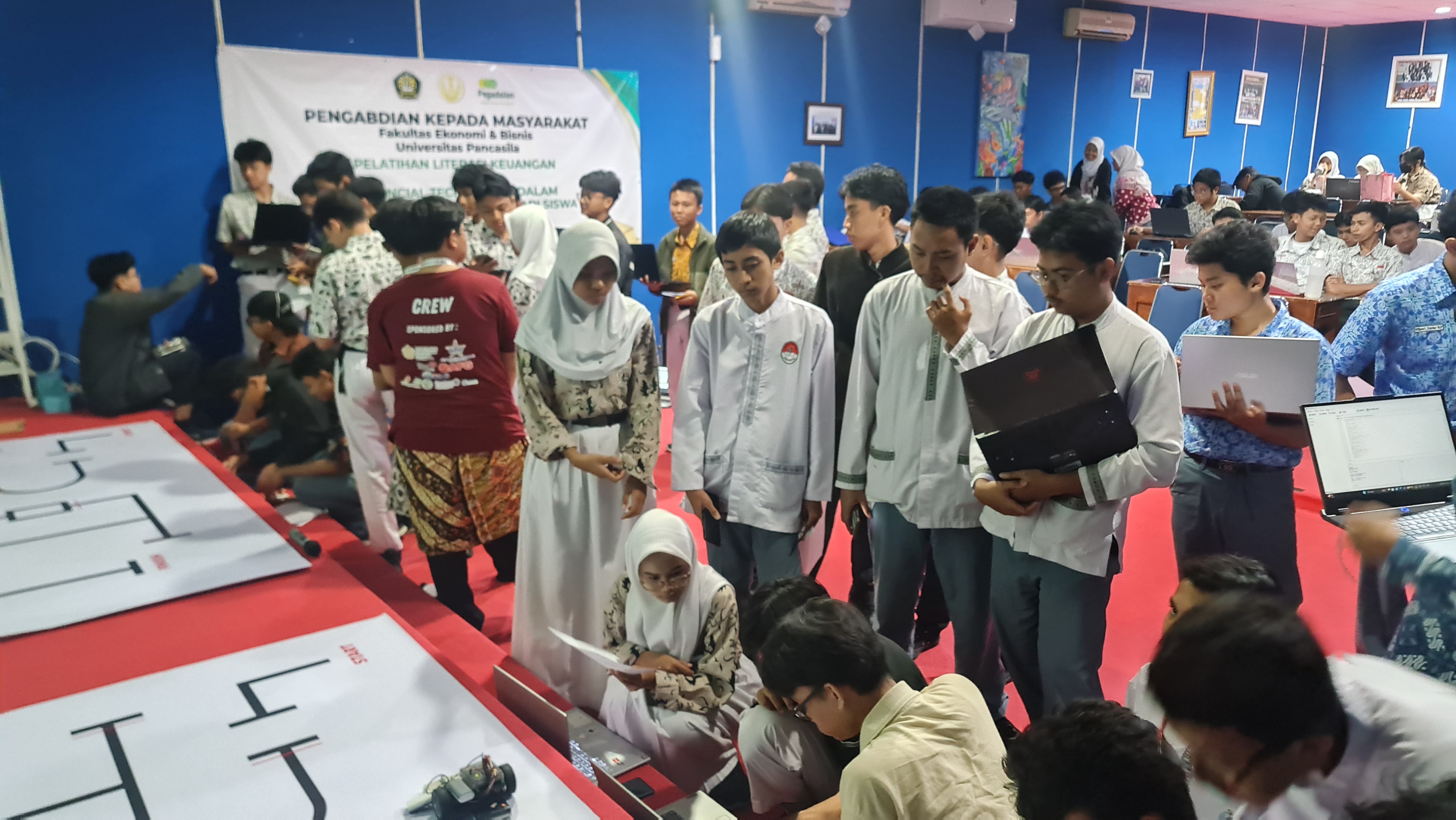
Maze Solving is intended for senior high school students or equivalent. The maze-solving
competition is a type of robotics competition designed to train participants' thinking skills
in solving a given track using specific algorithms to reach the finish line in the fastest time
possible. The track has a white base color with black lines ±2 cm wide.
2. Robot Specifications
1. Each team is only allowed to use 1 robot and may carry a spare set of sensors.
2. The maximum robot dimensions are 25x25x25 cm with no weight limit.
3. Robots must be self-assembled or built using a kit.
4. Robots must not damage the arena.
5. Robots must operate automatically (remote controls are not allowed).
6. Robots must be brought to the arena in an assembled state.
7. Robots must use wheels.
8. There are no limits on the sensors used.
9. The maximum voltage for the robot is 12V.
10. Robots are not allowed to have any form of communication device.
3. Competition Rules
3.1. Competition Method
1. The committee will inspect participants' robots; if the robot does not meet the
specifications, participants must adjust their robots.
2. The competition system uses a time beat system.
3. The team with the fastest time will be the winner.
4. The programming duration is approximately 60 minutes.
5. Each team is given 3 minutes (180 seconds) to complete the maze.
6. During the programming session, supervisors are not allowed to enter the
competition area or communicate with participants.
7. During the competition, Bluetooth and Wi-Fi on laptops and mobile phones must be
turned off.
8. During the competition, participants are not allowed to touch their robots without
the referee's permission.
9. Robots that take shortcuts must retry.
10. Participants are allowed to retry as long as there is remaining competition time.
11. If the allotted time ends and the robot has not yet reached the finish line,
participants must stop their robot as per the jury's instructions, and the attempt will
be considered incomplete.
12. The jury's decision is final and cannot be contested.
3.2. Judging Criteria
1. Competition
● The winner is determined based on the lowest score obtained by the participant.
● Retry opportunities are given if the robot stops or completely leaves the track
and are conducted after a signal from the referee.
● Participants are required to pass through every checkpoint on the track.
● When a retry is performed during an assessment session, the score will be reset
for that session
3.3. Determining the Winner
1. The winner is the robot that successfully completes the track and reaches
the finish line in the fastest time.
3.4. Scoring Mechanism
1. Participants are required to pass through every checkpoint on the track. The winner
will be determined based on the lowest score obtained using the following formula:
Score = Time - (Points x 10) + (Penalties x 10)
Explanation:
1. Time: The time taken by the participant from the start to the finish line. If the robot does not
reach the finish line, the time used in the calculation is 180 seconds (the maximum time).
2. Points: The number of points successfully collected or passed by the robot while traversing
the track.
3. Penalties: The number of points missed or not passed by the robot while traversing the track.
3.5. Competition Arena
1. The arena material is made of printed banner material with the following
dimensions
Lenght : 2,5 m
Widht : 2,5 m
2. The lines are black on a white background or vice versa.
3. The line width ranges from 1-2 cm.
4. The main arena will be provided during the competition, and the checkpoint/mission
details will be announced at the time of the competition.
5. There are designated start and finish points.
Full Rules link